As a supplier of head foot operated high-frequency (HF) welding machines, I often encounter various inquiries from customers about the capabilities of our products. One question that has come up more frequently lately is whether our head foot operated HF welding machine can be used for welding glass materials. In this blog post, I’ll delve into the technical aspects of HF welding, the properties of glass, and explore the feasibility of using our machine for glass welding. Head Foot Operated HF Welding Machine

Understanding Head Foot Operated HF Welding Machines
Before we discuss the possibility of welding glass, it’s essential to understand the basic principles of head foot operated HF welding machines. These machines utilize high-frequency electromagnetic fields to generate heat within the materials being welded. The operator controls the welding process using foot pedals and a hand-operated head, allowing for precise manipulation and pressure application during the welding operation.
HF welding is particularly effective for thermoplastic materials. When a high-frequency current passes through a thermoplastic, the polar molecules within the material start to vibrate rapidly due to the alternating electromagnetic field. This molecular friction generates heat, which softens the plastic and creates a bond when pressure is applied. The key advantage of HF welding is its speed, efficiency, and the ability to create strong, sealed joints without the need for additional adhesives.
Properties of Glass
Glass is a non – crystalline, amorphous solid that is typically transparent or translucent. It is made by melting silica sand with other materials like soda ash and limestone at very high temperatures. The unique molecular structure of glass consists of a random network ofsilicon and oxygen atoms, which gives it several distinct properties.
One of the most important properties of glass is its high melting point. Depending on the type of glass, the melting point can range from around 1000°C to 1700°C. Glass is also a poor conductor of electricity, which means it does not respond well to electrical currents like thermoplastic materials do. Additionally, glass is brittle and has a relatively low coefficient of thermal expansion, which can cause it to crack if it experiences rapid temperature changes.
Analyzing the Feasibility of Welding Glass with HF Welding Machines
Electrical Conductivity
As mentioned earlier, HF welding relies on the interaction between a high – frequency electromagnetic field and the polar molecules in a material to generate heat. Since glass is a poor conductor of electricity and has a non – polar molecular structure, it does not have the necessary polar molecules to be directly heated by the high – frequency current in an HF welding machine. The lack of electrical conductivity means that the high – frequency field will not cause the molecules in the glass to vibrate and generate heat, which is the fundamental mechanism of HF welding.
Melting Point
The high melting point of glass is another significant obstacle. Head foot operated HF welding machines are designed to work with materials that can be softened or melted at relatively low temperatures, typically in the range of 100 – 300°C for common thermoplastics. The extremely high temperatures required to melt glass are far beyond the capabilities of these machines. Even if by some means we could heat the glass, the structure of the machine is not designed to withstand such high temperatures, which would likely cause damage to its components.
Thermal Expansion
The low coefficient of thermal expansion and brittleness of glass pose additional challenges. During the welding process, rapid heating and cooling can cause significant thermal stress in the glass. Since glass is not very flexible, these thermal stresses can lead to cracks and fractures, making it difficult to create a strong and reliable weld.
Alternative Welding Methods for Glass
While head foot operated HF welding machines are not suitable for welding glass, there are other welding methods that are commonly used for this purpose.
Laser Welding
Laser welding is a highly precise method that uses a focused laser beam to melt and fuse the glass. The laser can be precisely controlled, allowing for very small and accurate welds. It can also be used to weld different types of glass, including optical and specialty glasses.
Flame Welding
Flame welding involves using a high – temperature flame, typically produced by a torch, to heat the glass to its melting point. This method is more suitable for larger glass components and is often used in glassblowing and some industrial applications.
Adhesive Bonding
Adhesive bonding is another option for joining glass parts. Specialized glass adhesives can provide a strong bond between glass components without the need for high temperatures. However, the strength of the bond may not be as high as a welded joint in some cases.
Conclusion
In summary, as a supplier of head foot operated HF welding machines, I must conclude that our machines are not suitable for welding glass materials. The electrical conductivity, high melting point, and thermal expansion properties of glass make it incompatible with the working principles of HF welding. However, our machines excel in welding a wide range of thermoplastic materials, including PVC, TPU, and EVA, which are commonly used in industries such as automotive, packaging, and textiles.
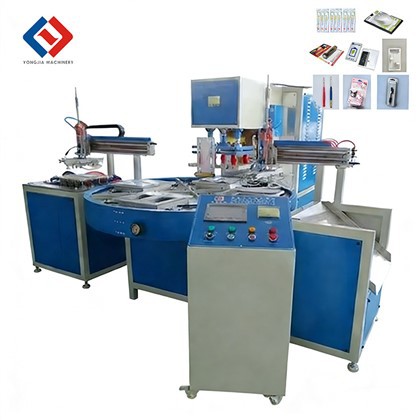
If you are in need of welding solutions for thermoplastic materials, our head foot operated HF welding machines offer reliable performance, precision, and efficiency. We have a team of experts who can provide you with detailed information about our products, help you choose the right machine for your specific needs, and offer technical support throughout the purchasing and operation process.
Synchronous Fusing HF Welding Machines If you’re interested in discussing your welding requirements further, please feel free to reach out to us to start a conversation. We’re eager to work with you to find the best welding solutions for your business.
References
- "High – Frequency Welding: Principles and Applications" by Industrial Welding Handbook
- "Glass Science and Technology" by D. R. Uhlmann and N. J. Kreidl
- "Welding Processes for Glass" by Journal of Glass Technology
Dongguan Yongjia Machinery Equipment Co., Ltd.
We are one of the most reliable head foot operated hf welding machine manufacturers and suppliers in China, specialized in providing high quality customized service. Please feel free to wholesale advanced head foot operated hf welding machine at low price from our factory. For quotation, contact us now.
Address: No. 240, Chashan South Road, Chashan Town, Dongguan City, Guangdong Province, China
E-mail: info@yjwelding.com
WebSite: https://www.yjhighfrequencymachine.com/
